Sunday, 10 August 2014
Students Present at NZILA Auckland Branch Event
(Post by Peter Griffiths) The Unitec X-section journal team presented at the annual 2x2 event held by the NZILA Auckland Branch on the 6th August. The team was there to encourage industry contributions to the journal - which aims to present a collaborative student/staff/industry view on this year's topic of Exchange. We look forward to exciting things to come from this years journal.
Tuesday, 5 August 2014
Kingsland Pocket Park Competition
(Posted by Renee Davies)
Unitec BLA students from all years have the exciting opportunity to enter design ideas into a competition organised by Alsco (landowners) and supported by Urbanlogic landscape architects, Kingsland Business Association and Auckland Council.
The competition is to design a small pocket park in Kingsland and the winning design will be built this year! The winning student designer will get to work with Urbanlogic and contractors on the implementation of the design on the ground - a great opportunity to work through an entire design process.
About 10 groups of interested students met on site in Kingsland today to be briefed by the client. Its a challenging site with a number of constraints, but students are all excited about the potential to create some exciting and innovative responses for the site.
The competition closes on 29th August - so we'll keep you posted on the outcomes and results!
Unitec BLA students from all years have the exciting opportunity to enter design ideas into a competition organised by Alsco (landowners) and supported by Urbanlogic landscape architects, Kingsland Business Association and Auckland Council.
The competition is to design a small pocket park in Kingsland and the winning design will be built this year! The winning student designer will get to work with Urbanlogic and contractors on the implementation of the design on the ground - a great opportunity to work through an entire design process.
About 10 groups of interested students met on site in Kingsland today to be briefed by the client. Its a challenging site with a number of constraints, but students are all excited about the potential to create some exciting and innovative responses for the site.
The competition closes on 29th August - so we'll keep you posted on the outcomes and results!
Wednesday, 30 July 2014
Gardens for SuperLot 8 at Hobsonville Point
![]() |
Rod Chadwick (AV Jennings) presenting Jiachen Xu with his award for innovative design.
|
Diploma in Landscape Design studios had the opportunity to come up with garden designs for terrace houses at Hobsonville Point this semester. AV Jennings generously arranged judging, and a prizegiving for top second year student designs from Jiachen Xu, Catherine Civil, Anna McCormack, Leigh Nicholson and Vanny Tirta Sari.
Tuesday, 29 July 2014
Department Bicultural Strategy
A Bicultural Strategy for the Department was given the ‘green light’ by
staff after being supported by the Maori Advisory Group (MAC) early in the New
Year. The purpose of the Strategy is to expand and contribute to mātauranga
Māori by providing facilities, research, support and advocacy for staff,
students and visitors. This is to align with and support the developing
landscape architecture profession’s bicultural strategy.
There are several key aspects of the strategy aimed to bring about
changes. The first is to open a resource office in the centre of the department
for staff, students, and kaumātua who are invited to visit the Department (more
about that below). The Strategy also provides for mentoring of Māori students,
support for the MAC group, two seminars or hui on Māori topics per year, and
improved Māori practices, knowledge and curricular content. Copies of the
Strategy are available from the Department.
The contribution to the Strategy of one of our students needs
highlighting. Tosh Grahame took on organising three (one extra) seminars this
year, which will be a major asset to the Department. The seminar series kicks
off Māori Language Week for the first seminar, and the series is notified
separately. In short the dates are:
·
July 24 Haare Williams on Whenua:
Kaitiakitanga;
·
August 7 Pita Ture on Whenua:
Wairuatanga; and
·
September 18 Malcolm Paterson on
Whenua: Mauritanga.
Each seminar is on Thursday 12.30- 1.30pm and they
will be popular events for landscape architects seeking to expand their
knowledge of mātauranga Māori, as well as with other colleagues.
The Resource
(whanau) Room
Centrally situated this room is now ready for gatherings and other use.
Equipped with two desks for staff or students, it also has a comfortable sofa,
with room for small meetings. Māori resource material for inspiration and
research is beginning to expand through donations. We anticipate a motif to
call attention to the room, on glass to be designed by student Natalie Couch. In
addition, students will be called to a meeting to discuss and provide
information for the Maori carver who has agreed to prepare a lintel or other
carving for the room. The MAC members, students and staff will also be asked to
contribute research on Unitec and ideas to formulate a name for the room, which
we would then submit to authorities for agreement. The intention is that this
room will be a physical base to provide support for students and staff and will
encourage expansion of research and knowledge. Join us there.
Teaching in China
By Susannah Kitching
Over 3 weeks in May the department presented courses, commissioned by
the Landscape Bureau of Wuhan City, Hubei Province. Wuhan is the fifth largest
Chinese city of approximately 8 million, growing at an extremely rapid pace,
with aspirations to join the first tier cities of Beijing and Shanghai. It is
an industrial city, with a new focus on the production of optics.
Leo Zhang, who invited Renee Davies and Ian Henderson to Wuhan last
September, had organized these courses. Ian, Susannah Kitching, and Yue Yu, of
Xanthe White Design, who translated, delivered them. The focus of the modules
was on planting design, green infrastructure, low impact design (LID), and new
management technologies. This teaching was done in collaboration with Chris
Bentley, director of Boffa Miskell, Shanghai, and Swallow Wang, who presented
their Chinese projects.
The Landscape Bureau has 1400 employees, with 13 district offices, a
Design Institute of 180 and responsibility for the management of many parks,
streets, nurseries and even a bonsai department.
In total 120 Landscape Bureau employees attended the presentations,
received
course books, which had been produced by Susannah, and were presented
with attendance certificates.
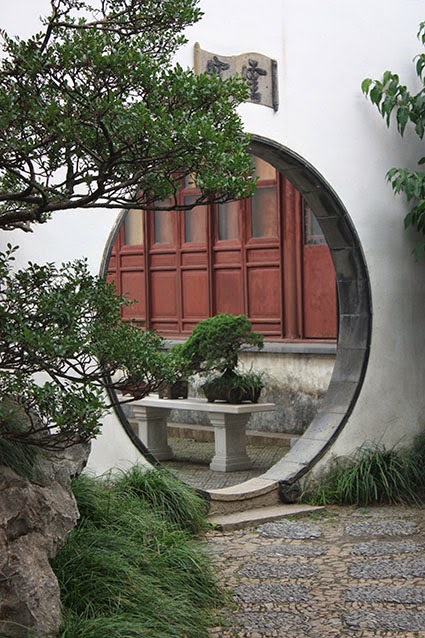
While in China staff had the priviledge of visiting some of the famous traditional gardens of Suzhou - images follow of these inspiring Chinese gardens.
A Great Read...
Wicked Plants – The weed that killed Lincoln’s mother & other botanical atrocities
by Amy Stewart
A delightful little book which explores the ethnobotany of poisonous plants “…an A – Z of plants that kill, maim, intoxicate and othewise offend” and the cultural and historical impact these have had on humans. The book is beautifully illustrated with etchings of each plant and provides a unique insight into the role of plants in human society and the often fine line between beneficial and deadly. A fascinating journey, the style of the book allows you to pick it up and read about one particular plant at a time and the historical examples of the impact of each plant are insightful and sometimes shocking. A must for anyone who is interested in the power and mystery of the botanical world.
Book Review by Renee Davies
2009 Algonquin Books
ISBN-13: 978-1-56512-683-1
Rainforest Journeys
| Traditional boat transporting students down river |
(by Renee Davies & Students)
This years Pacific Regional Studies course took a group of students deep into the precious and diminishing rainforests of Sarawak, Malaysia to spend a week with one of the last nomadic tribes living in the rainforest – the Penan.
The journey tested students and staff
physically and mentally but provided a unique cultural immersion experience and
an opportunity to explore and appreciate the inter-relationships between the
indigenous Penan people and their environment, and gave insights about
relationships between landscape and culture.
Trekking from village to village and talking
to the local Penan people showed that that there is considerable concern
amongst them about their future. Concern over their rainforest that is being
cut into from all sides, concern over what this was doing to their rivers and
concern over the many dams being built which are flooding vast areas of land
and causing the relocation of many indigenous people. The Penan were keen to
tell their story and to let the world know that their environment and way of
life was being threatened.
In the words of Vanya, one the students, “Our trip raised questions of cultural
sustainability and importance of preserving cultural diversity and recognising
indigenous values. We were also reminded of the importance of protecting
ecological diversity and educating others about the importance and value of
conservation. The trip encouraged us to reconsider our own values and beliefs
and whether we would be willing to work on projects that are known to cause
massive environmental and cultural damage”.
A SCALA seminar - Revealing the Rainforest - by the students and staff
discussing the trip, cultural landscape
and rainforest conservation issues will be held on 21st August at
Unitec.
The following are some images from the trip.
| Traditional Penan house built from local hardwood timber |
| Butterflies gather to drink at edge of river |
| Students have a go at using Penan hunting blow-pipe |
| A night in the rainforest during trek to Penan village |
| Fern fronds gathered from forest on menu for dinner |
![]() |
| The Penan Peace Park - locals to try and save their forest |
![]() |
| Older Penan who grew up as full nomads in the forest |
| Traditional craft still used for everyday functions in the village |
![]() |
An open fire in the Penan house
- rainforest food and rice for dinner
- we all loved the home-grown
and gathered array of mainly vege food
|
![]() |
| Numerous river crossings to get to the village |
![]() |
Gathering our own food for dinner
- tapioca leaves -
|
| River trips were a highlight |
![]() |
| Orangutan in wild at rehabilitation centre |
Subscribe to:
Posts (Atom)